Facilitator Resources
Building The Capacity Of Educators
Suites of resources on a range of early STEAM topics for facilitators and coaches to use in professional learning with educators.
The California Department of Education released the P–3 Learning Progressions in math and science to support the alignment between preschool foundations and K–3 standards. The P–3 Learning Progressions provide:
The P–3 Learning Progressions can be used to plan for classroom learning experiences that build on each other from grade to grade, make choices about curricula and assessments, and inform professional learning for P–3 educators. Take some time to review the linked documents: P–3 Learning Progressions in Math;P–3 Learning Progressions in Science.
In the following slides, you will review the main components of the P–3 Learning Progression documents and how you might use these within your context.
If your agency serves infants and toddlers, be sure to consider how the California Infant/Toddler Learning and Development Foundations in Cognitive Development connect to the P–3 Learning Progressions in math and science.
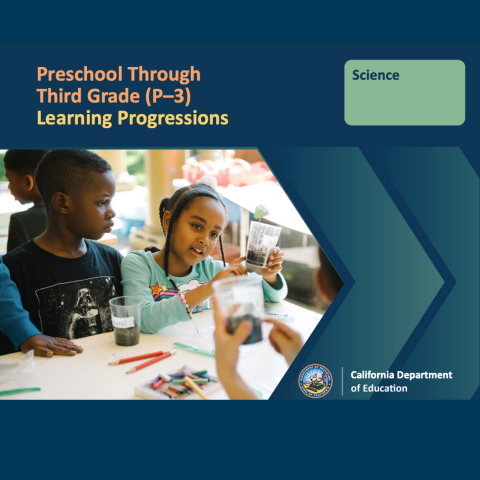

Each domain includes learning progressions tables organized by key areas of learning and development in math and science. The learning progressions tables present the continuum of the PTKLF and K–3 standards in each domain.
You can use the learning progressions with educators to highlight the continuity in children’s knowledge and skills and help plan learning experiences that are developmentally appropriate, meaningful, and connected to each other. Learning progressions can also help educators identify skills or knowledge that need to be strengthened or extended for individual children.
Each domain offers teaching practices educators can use to create engaging and playful inquiry experiences in math and science across grades.
Educators can consider how to build on children’s strengths, interests, prior knowledge, and diverse lived experiences to make math and science learning meaningful for them. They can plan how to create welcoming environments that honor children’s home languages, varied abilities, and forms of expression when demonstrating their understanding and skills.

Each key area has two examples that illustrate children’s learning in one learning progression across two different grades. The in-practice examples also illustrate how educators in different grades use consistent teaching practices to support children’s learning of a particular skill or concept.
Educators can review the in-practice examples for ideas on how to support children’s learning across grades. Educators can use the in-practice examples to spark their own planning and generate ideas for how to create playful, inquiry-based math and science learning experiences that are connected over time.
The P–3 Learning Progressions can be used in different ways to build alignment within your agency, including:
Watch the video where a CPE agency facilitator featured earlier in this module dives deeper into how the P–3 Learning Progressions are used with educators.
Review the case study, describing how one agency might use P–3 Learning Progressions in science to provide professional learning, promote co-planning, and engage families.

A midsized district formed a P–3 science team with preschool through third grade educators, instructional coaches, and family members to deepen continuity in science learning. Using the P–3 Learning Progressions in science, the team implemented a year long professional learning program: shared sessions across grades to analyze learning progression tables and teaching practices, followed by co planning among adjacent grades (for example, preschool–kindergarten, kindergarten–first grade, second–third grade).
Educators used in-practice examples to identify developmentally appropriate scaffolds and extensions for children’s learning of specific concepts and skills. During co-planning, teams mapped unit goals to the progressions, chose formative assessments, and designed inquiry based, culturally responsive learning experiences. Coaches led classroom demonstrations and cross grade observations, then guided reflective conversations to document children’s growth.
To strengthen family partnerships, the district invited families to science nights to showcase children’s learning and engage families in science experiences together, share progression summaries in accessible languages, and co design at home extension activities so families could explore concepts with their children at home.
Reflect:
What ideas does the case study inspire for how you might use the P–3 Learning Progressions to provide professional learning and coaching and engage families to support P–3 alignment in math and science?
Even though there are no P–3 learning progressions for computer science in California, there are useful resources that can help your agency create an approach for supporting P–3 educators and children in computer science."
Children can engage in computational thinking and computer science experiences early in their development. Computational thinking involves critical thinking and problem-solving skills used when engaging in computer science (Bers et al., 2022; Grover & Pea, 2013). Computer science is the study of computers and computational systems used to solve real-world problems (Bers et al., 2022). Refer to the Early Computer Science facilitator resources on this website (coming soon) to support educators in incorporating computational skills and computer science in everyday learning experiences and routines. The K–12 Computer Science Framework describes that computer science experiences in early childhood help build children’s skills for learning that happens later in their development.
The Computer Science Standards for California Public Schools articulate skills and knowledge that children further develop in kindergarten through third grade. The Progression of California K–12 Computer Science Standards shows how children grow in their understanding of computing systems, networks and the internet, data and analysis, algorithms and programming, and impacts of computing.
Reflect:
How might you use existing resources in computer science to create shared learning and planning opportunities for P–3 educators? How might you integrate computer science, math, and science across preschool through third grade?

As you reflect on how to strengthen your agency’s approach to P–3 alignment, you might consider some of the following next steps:
If you plan to conduct a professional learning experience with educators, refer to the Using Learning Progressions to Foster P–3 Alignment in Math and Science planning tool to help you record ideas for how you might use these resources to spark discussion among preschool through third grade educators and help them plan together.
Reflect:
Individually or with your team, decide on one next step you can take or support your agency in taking toward building P–3 alignment in math, science, and computer science.
Modules for leaders, professional learning facilitators, and coaches to build their knowledge and skills in how to provide early STEAM professional learning.
Suites of resources on a range of early STEAM topics for facilitators and coaches to use in professional learning with educators.
Copy the link below to share this resource with students, families and colleagues, or to save for later.